
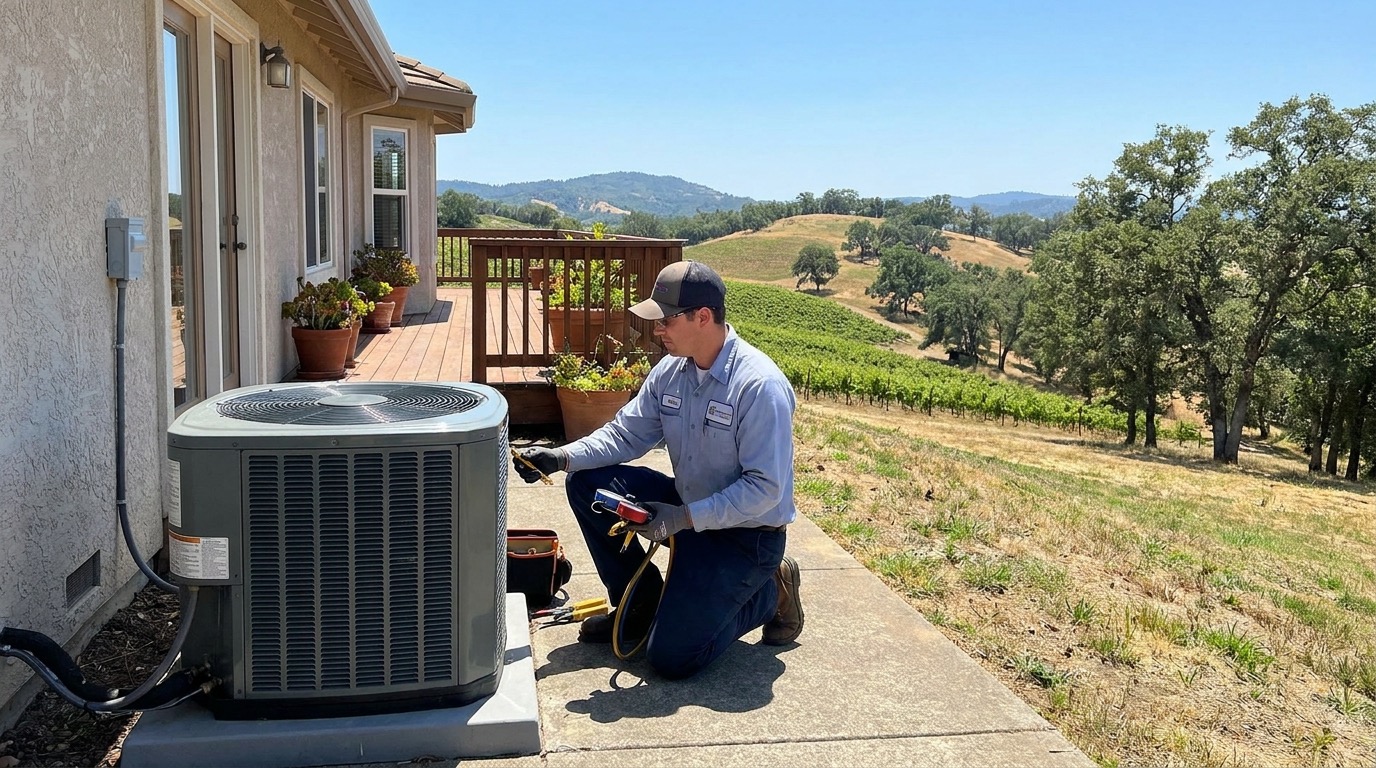
Sonoma County's climate swings from foggy coastal mornings to triple-digit inland afternoons, which makes the choice between a ductless mini-split system and a traditional central HVAC setup more than a matter of preference. The right system depends on your home's existing ductwork, room-by-room heating and cooling needs, and budget. This guide compares both options so you can have an informed conversation with a licensed contractor before you commit.
What Is the Difference Between Ductless and Central HVAC?
Central HVAC uses a single furnace or air handler connected to ductwork that distributes conditioned air throughout the house, controlled by one or a small number of thermostats. Ductless mini-split systems instead use an outdoor compressor connected to one or more wall-mounted indoor air handlers, each independently controlled — no ductwork required.
How Do the Two Systems Actually Heat and Cool a Home?
Central systems condition air at one point and push it through ducts to registers in each room, which works well when a home already has ductwork sized correctly for the space. Mini-splits condition air directly in the room where the indoor unit is mounted, so each zone can run at a different temperature — useful in additions, converted garages, or older Sonoma County homes where extending ductwork isn't practical.
Which Homes Are Better Suited to Ductless Systems?
Ductless systems tend to make the most sense in homes without existing ductwork, room additions that are hard to tie into a central system, and older farmhouses common in western Sonoma County where duct runs would mean cutting into plaster or tight crawl spaces. They're also a good fit for anyone wanting independent temperature control in a home office or converted ADU.
How Do Installation Costs Compare in Sonoma County?
Cost is usually the deciding factor once a homeowner understands both options.
What Does a Ductless Mini-Split Installation Typically Cost?
A single-zone ductless mini-split, covering one room or small addition, generally runs $3,000 to $6,000 installed in Sonoma County, including the outdoor compressor, one indoor head, and line-set installation. Multi-zone systems, which connect two to five indoor heads to one outdoor unit, typically cost $8,000 to $18,000 depending on the number of zones and the complexity of the line-set routing.
What Does a Central HVAC System Cost by Comparison?
A full central air conditioning and furnace replacement for an average Sonoma County home runs $8,000 to $25,000, and that estimate climbs significantly if the home doesn't already have ductwork — retrofitting an older home with new ducts can add $6,000 to $15,000 on its own. If usable ductwork already exists, swapping in a new central system is often more cost-effective per square foot of coverage than an equivalent multi-zone ductless setup.
Which System Is More Energy Efficient?
Efficiency depends heavily on how the home is actually used day to day.
Do Ductless Systems Save More Energy Than Central Air?
Ductless mini-splits avoid the 20-30% energy loss that's typical in central systems with leaky or poorly insulated ductwork — a common issue in older homes. Because each zone can be turned off or set back independently, ductless systems also let homeowners avoid conditioning empty rooms, which central systems can't easily do without zoning dampers.
Are There Rebates Available for Either System in Sonoma County?
PG&E offers rebates for qualifying high-efficiency heat pump systems, including ductless mini-splits, and the Bay Area Air Quality Management District periodically runs incentive programs for replacing older gas furnaces with electric heat pump equipment. Federal tax credits of up to 30% are available through 2032 for qualifying heat pump installations under the Inflation Reduction Act, and this applies to both ducted and ductless heat pump systems. A licensed contractor should be able to confirm which current rebates apply to your specific equipment choice.
How Do You Decide Which System Is Right for Your Home?
The right answer depends on your home's construction, your budget, and how you actually live in the space.
When Does It Make Sense to Keep Central HVAC?
If your home already has functional, well-sealed ductwork and you want whole-house conditioning from a single thermostat, replacing a central system is usually simpler and often more cost-effective than converting to ductless. Central systems also integrate more easily with whole-home air filtration and humidity control equipment.
When Does a Ductless System Make More Sense?
If you're heating or cooling an addition, a home without ductwork, or want room-by-room control — say, keeping a home office cooler during the day without conditioning the whole house — a ductless mini-split is typically the more efficient and less invasive option. Many Sonoma County homeowners also use a hybrid approach: central HVAC for the main living areas and a ductless mini-split for a converted garage, ADU, or addition.
What Should You Ask a Contractor Before Deciding?
Ask for a Manual J load calculation specific to your home rather than a rule-of-thumb estimate, request the SEER2 and HSPF2 efficiency ratings for any proposed equipment, and confirm the contractor holds a current C-20 (Warm-Air Heating, Ventilating and Air-Conditioning) license from the CSLB. Anyone handling refrigerant lines should also be EPA Section 608 certified. Getting quotes for both a ductless and a central option — where both are feasible for your home — makes the cost and efficiency tradeoffs concrete rather than theoretical.
Find HVAC pros near you
Compare ratings, read reviews, and connect with top-rated HVAC professionals in Sonoma County.